Piaget Understanding Concept: Phases Of Cognitive Advancement
by TeachThought Personnel
Jean Piaget (1896 – 1980 was a Swiss psychologist and among the most significant figures in developing psychology.
Piaget is best recognized for his introducing work with the cognitive development of children. His research reinvented our understanding of how children find out and expand intellectually. He recommended that children proactively create their understanding with stages, each characterized by distinct methods of thinking and understanding the globe.
His concept, ‘Piaget’s phases of cognitive development,’ has profoundly affected official education and learning, stressing the relevance of customizing training methods to a child’s cognitive developing stage instead of anticipating all kids to discover similarly.
Jean Piaget’s concept of cognitive development details a collection of developing stages that youngsters progress with as they expand and develop. This concept recommends that kids actively create their understanding of the globe and distinct cognitive capacities and methods of assuming characterize these stages. The 4 primary phases are the sensorimotor stage (birth to 2 years), the preoperational phase (2 to 7 years), the concrete functional stage (7 to 11 years), and the official operational phase (11 years and past).
See additionally Levels Of Combination Of Critical Believing
A Quick Recap Of Piaget’s Phases Of Cognitive Growth
In the sensorimotor phase, babies and kids find out about the globe through their detects and actions, progressively establishing item permanence. The preoperational stage is marked by the introduction of symbolic idea and the use of language, although logical thinking is limited. The concrete operational phase sees kids begin to think more rationally regarding concrete events and items.
Lastly, in the official operational phase, teens and adults can believe abstractly and hypothetically, enabling more intricate problem-solving and thinking. Piaget’s concept has actually influenced teaching techniques that straighten with students’ cognitive advancement at different ages and phases of intellectual growth.
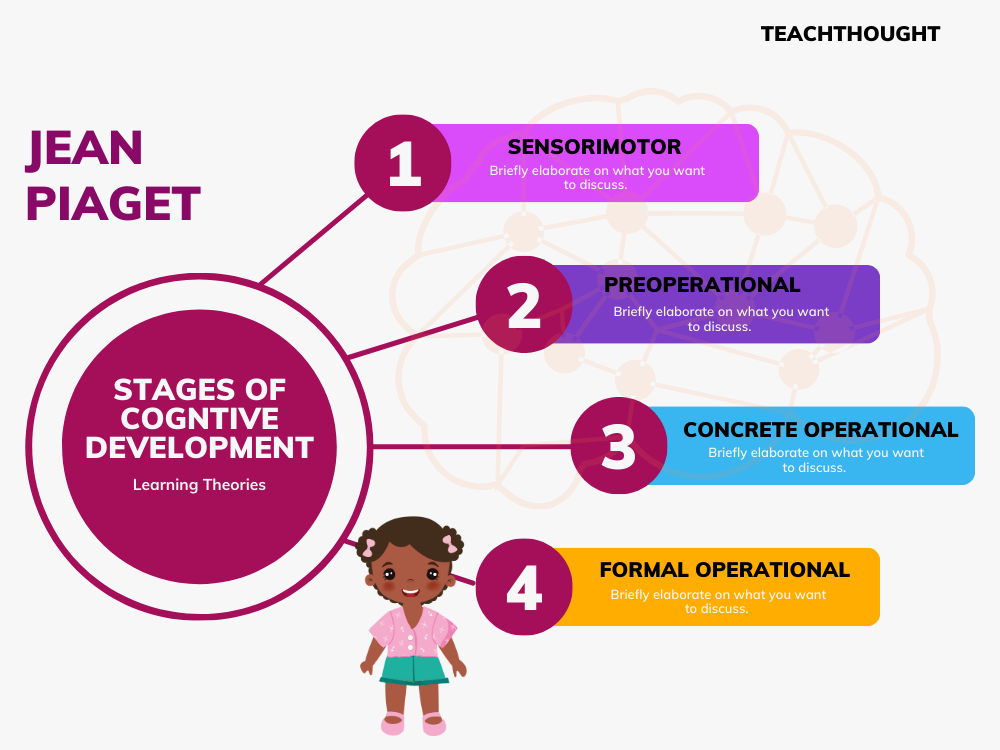
Piaget’s 4 Phases Of Cognitive Development
Piaget’s Stage 1: Sensorimotor
Piaget’s sensorimotor stage is the preliminary developmental stage, commonly taking place from birth to around two years of age, during which infants and young children largely find out about the globe through their senses and physical actions.
Secret attributes of this stage consist of the growth of item durability, the understanding that items remain to exist also when they are not visible, and the gradual development of basic mental representations. Initially, babies participate in reflexive habits, however as they proceed through this stage, they start to purposefully collaborate their sensory understandings and motor skills, exploring and adjusting their environment. This stage is noted by significant cognitive growth as kids transition from totally natural responses to extra deliberate and coordinated interactions with their environments.
One example of Piaget’s sensorimotor phase is when a child plays peek-a-boo with a caregiver. In the very early months, an infant does not have a feeling of object permanence. When an item, like the caregiver’s face, goes away from their sight, they might act as if it no more exists. So, when the caretaker covers their confront with their hands during a peek-a-boo game, the baby might respond with shock or light distress.
As the infant progresses with the sensorimotor phase, normally around 8 to 12 months, they begin to establish things permanence. When the caregiver conceals their face, the baby understands that the caregiver’s face still exists, despite the fact that it’s temporarily out of sight. The baby might react with anticipation and excitement when the caretaker uncovers their face, demonstrating their developing ability to form psychological depictions and realize the idea of item durability.
This progression in understanding is a key attribute of the sensorimotor stage in Piaget’s theory of cognitive development.
Piaget’s Phase 2: Preoperational
Piaget’s preoperational phase is the second stage of cognitive growth, generally taking place from around 2 to 7 years old, where kids begin to create symbolic reasoning and language skills. Throughout this stage, youngsters can represent objects and concepts using words, pictures, and signs, enabling them to participate in pretend play and interact more effectively.
Nevertheless, their reasoning is identified by egocentrism, where they have a hard time to think about other people’s viewpoints, and they exhibit animistic reasoning, associating human top qualities to inanimate objects. They additionally lack the ability for concrete logic and struggle with jobs that require understanding preservation, such as acknowledging that the volume of a fluid remains the exact same when poured into different containers.
The Preoperational phase stands for a substantial change in cognitive development as kids shift from fundamental sensorimotor reactions to advanced symbolic and representational thought.
One instance of Piaget’s preoperational stage is a kid’s understanding of ‘preservation.’
Visualize you have two glasses, one tall and slim and the various other brief and broad. You put the very same amount of liquid right into both glasses to have the exact same quantity of liquid. A kid in the preoperational phase, when asked whether the amount of fluid is the same in both glasses, might claim that the taller glass has even more fluid due to the fact that it looks taller. This shows the child’s failure to recognize the principle of conservation, which is the idea that even if the appearance of a things changes (in this instance, the shape of the glass), the amount continues to be the exact same.
In the preoperational phase, children are frequently concentrated on one of the most popular affective facets of a situation and struggle with more abstract or logical thinking, making it challenging for them to realize preservation principles.
Piaget’s Phase 3: Concrete Operational
Piaget’s Concrete Operational phase is the third stage of cognitive growth, normally taking place from around 7 to 11 years old, where children show enhanced logical thinking and problem-solving capabilities, specifically in relation to concrete, concrete experiences.
Throughout this stage, they can comprehend principles such as preservation (e.g., recognizing that the quantity of fluid continues to be the very same when poured right into different containers), and reversibility (e.g., comprehending that an action can be reversed). They can carry out standard psychological operations like enhancement and subtraction. They come to be much more capable of thinking about different viewpoints, are much less self-concerned, and can take part in more organized and organized thought processes. Yet, they might still deal with abstract or hypothetical thinking, an ability that emerges in the subsequent official operational phase.
Visualize 2 the same containers full of the very same quantity of water. You pour the water from among the containers into a taller, narrower glass and put the water from the other right into a much shorter, wider glass. A youngster in the concrete functional phase would certainly have the ability to identify that both glasses still consist of the same amount of water regardless of their various forms. Kids can understand that the physical appearance of the containers (tall and narrow vs. short and vast) doesn’t change the quantity of the liquid.
This capacity to comprehend the principle of preservation is a characteristic of concrete operational reasoning, as kids become a lot more experienced at rational thought related to genuine, concrete situations.
Stage 4: The Formal Operational Phase
Piaget’s Formal Operational phase is the 4th and final stage of cognitive growth, typically arising around 11 years and continuing right into the adult years. During this stage, individuals get the capability for abstract and theoretical thinking. They can solve intricate troubles, believe critically, and reason concerning principles and concepts unrelated to concrete experiences. They can participate in deductive thinking, thinking about multiple possibilities and potential end results.
This stage enables sophisticated cognitive capacities like understanding scientific concepts, planning for the future, and contemplating moral and honest dilemmas. It stands for a considerable shift from concrete to abstract thinking, making it possible for people to discover and recognize the world a lot more comprehensively and imaginatively.
An Example Of The Official Operation Stage
One example of Piaget’s Formal Operational stage entails a young adult’s ability to assume abstractly and hypothetically.
Imagine offering a young adult with a traditional moral predicament, such as the ‘cart trouble.’ In this circumstance, they are asked to think about whether it’s morally appropriate to draw a bar to draw away a trolley far from a track where it would certainly strike 5 people, however in doing so, it would certainly after that strike someone on an additional track. A teenager in the formal operational stage can participate in abstract ethical reasoning, considering numerous ethical principles and prospective consequences, without depending exclusively on concrete, personal experiences.
They might consider utilitarianism, deontology, or other honest structures, and they can think of the theoretical results of their choices.
This abstract and hypothetical reasoning is a hallmark of the official operational stage, showing the ability to reason and reflect on complex, non-concrete issues.
Just How Teachers Can Use Piaget’s Stages Of Advancement in The Class
1 Specific Distinctions
Recognize that kids in a class might be at different phases of growth. Dressmaker your mentor to fit these differences. Give a selection of activities and methods to deal with numerous cognitive degrees.
2 Constructivism
Identify that Piaget’s theory is rooted in constructivism, indicating kids actively develop their expertise with experiences. Motivate hands-on knowing and exploration, as this straightens with Piaget’s focus on discovering through interaction with the environment.
3 Scaffolding
Be prepared to scaffold instruction. Pupils in the earlier phases (sensorimotor and preoperational) may need extra advice and assistance. As they proceed to concrete and formal functional stages, slowly enhance the intricacy of jobs and give them extra independence.
4 Concrete Instances
Students benefit from concrete examples and real-world applications in the concrete operational stage. Usage concrete products and functional troubles to assist them realize abstract ideas.
5 Active Knowing
Promote active understanding. Urge students to think critically, solve problems, and make links. Use open-ended concerns and motivate discussions that help pupils relocate from concrete believing to abstract reasoning in the formal operational phase.
6 Developmentally Suitable Educational Program
Ensure that your curriculum aligns with the pupils’ cognitive abilities. Introduce abstract ideas considerably and connect new finding out to previous expertise.
7 Regard for Distinctions
Be patient and respectful of private differences in advancement. Some students might understand principles earlier or behind others, which’s totally regular.
8 Analysis
Create evaluation approaches that match the trainees’ developing stages. Examine their understanding utilizing approaches that are suitable to their cognitive capabilities.
9 Expert Growth
Teachers can remain updated on the most recent youngster development and education and learning research study by going to expert growth workshops and teaming up with colleagues to consistently fine-tune their mentor methods.